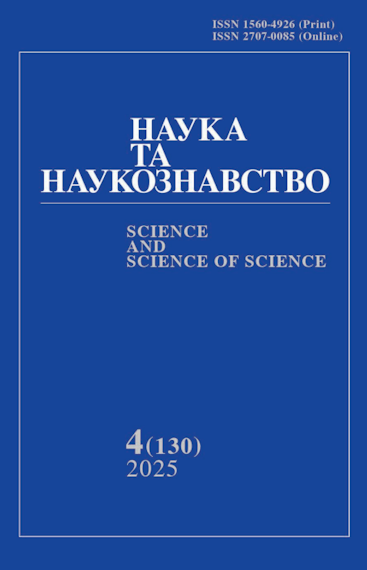
Довіра до вчених у вимірі міжнародних і національних опитувань
DOI:
https://doi.org/10.15407/sofs2025.04.023Ключові слова:
соціальний капітал науки, довіра громадськості до науки, довіра до вчених, дослідження Wellcome Global Monitor, індекс довіри до вчених, науковий популізм, участь учених у політичному процесі, комунікація між ученими і громадськістю.Анотація
У статті викладено результати міжнародних і національних опитувань щодо рівня довіри суспільства до вчених. Новизна дослідження полягає у комплексному аналізі показників довіри до науковців в Україні у контексті регіональних відмінностей та впливу кризових явищ (пандемії та повномасштабної війни), а також у виявленні унікальних для українського суспільства чинників довіри / недовіри. Систематизовано різні підходи до вимірювання соціального капіталу науки, рівня довіри до науки в міжнародному та національному контекстах. Аналіз виконано з використанням компаративного підходу, який поєднує кількісний аналіз соціологічних даних з якісним осмисленням суспільного контексту. Джерелами аналізу є результати міжнародних досліджень громадської думки Wellcome Global Monitor (2018), Many Labs «Довіра до науки та популізм, пов’язаний з наукою» (TISP), а також опитування Pew Research Center (2024). Аналіз Wellcome Global Monitor (2018) показав, що в Україні рівень довіри до вчених виявився подібним до середнього в світі. За результатами аналізу TISP виявлено, що респонденти з України підтримують спілкування вчених із громадськістю та необхідність донесення наукових висновків до політиків, проте значна їх частина висловлюється проти активного залучення учених до політичного процесу; це свідчить, що в українському суспільстві комунікація науковців з громадськістю та політиками сприймається більш позитивно, ніж їх активне втручання у політику. Особливу увагу приділено опитуванню «Соціальні виміри суспільства» Інституту соціології НАН України за період 2015—2019 рр. Виявлено помірний, але нестабільний рівень довіри до вчених в Україні до початку повномасштабної війни, а також значну частку респондентів з невизначеною позицією в цьому питанні. Доведено, що довіра до вчених в Україні до 2019 р. була однією з найвищих серед усіх інститутів суспільства, випереджаючи ЗМІ, політиків та правоохоронні органи. Підкреслено, що висока довіра до науковців створює підґрунтя для їхньої ключової ролі у формуванні державної політики та подоланні суспільних викликів. Розкрито значення моніторингових опитувань довіри до вчених в Україні для розроблення ефективних стратегій наукової комунікації в умовах війни та повоєнного відновлення. Обґрунтовано необхідність проведення нових комплексних опитувань з урахуванням регіональних особливостей, впливу дезінформації та диференціації довіри до різних галузей науки.
Посилання
Kabat, G.C. (2017). Taking distrust of science seriously. EMBO Reports, 18(7), 1052–1055. https://doi.org/10.15252/embr.201744294
Iyengar, S., & Massey, D.S. (2019). Scientific communication in a post-truth society. Proceedings of the National Academy of Sciences of the United States of America, 116(16), 7656–7661. https://doi.org/10.1073/pnas.1805868115
Rudroff, T. (2025). The growing tide of antiscience sentiment: A global concern. World Medical & Health Policy, 17(3), 529–537. https://doi.org/10.1002/wmh3.70022
Bourdieu, P. (1986). The forms of capital. In J.G. Richardson (Ed.), Handbook of Theory and Research for the Sociology of Education (pp. 241–258). New York: Greenwood Press. URL: https://www.marxists.org/reference/subject/philosophy/works/fr/bourdieu-forms-capital.htm (accessed: 29.12.2025).
Popovych, O. (2007). Let’s stop devaluation of science social capital! Visnyk Natsionalnoi Akademiyi Nauk Ukrayiny, (12), 8–15. [in Ukrainian].
Popovych, O.S. (2015). On the urgent need for action aimed at the capitalization of the social and psychological components of scientific and technological potential. Science and Innovation, 11(4), 5–12. https://doi.org/10.15407/scin11.04.005 [in Ukrainian].
Krause, N.M., Scheufele, D.A., Freiling, I., & Brossard, D. (2021). The trust fallacy: Scientists’ search for public pathologies is unhealthy, unhelpful, and ultimately unscientific. American Scientist, 109(4), 226–233. https://doi.org/10.1511/2021.109.4.226
Altenmüller, M.S., Wingen, T., & Schulte, A. (2024). Explaining polarized trust in scientists: A political stereotype-approach. Science Communication, 46(1), 92–115. https://doi.org/10.1177/10755470231221770
Cologna, V., Mede, N.G., Berger, S., Besley, J., Brick, C., Joubert, M., ... & van der Linden, S. (2025). Trust in scientists and their role in society across 68 countries. Nature Human Behaviour, 9(4), 713–730. https://doi.org/10.1038/s41562-024-02090-5
Petrushina, T.O. (2017). The state of science in Ukraine (based on the assessments of Ukrainian and foreign experts). Visnyk Natsionalnoi Akademiyi Nauk Ukrayiny, (11), 66–80. https://doi.org/10.15407/visn2017.11.066 [in Ukrainian].
Yashchyshyna, I.V., & Popovych, O.S. (2012). Social capital of Ukrainian science through the eyes of students. Problems of Science, (6), 22–27. [in Ukrainian].
Salnikova, S., Muradyan, O., & Sydorov, M. (2020). International macrosocial indicators as analytical tools in sociology. Sociological Studios, (2)17, 41–54. https://doi.org/10.29038/2306-3971-2020-02-41-54 [in Ukrainian].
Borozdykh, N.V. (2024). Trust in scientists and their role in society. In XXII International Youth Scientific and Practical Conference “History of the Development of Science, Technology and Education” on the topic “High Technologies and Modern Challenges” (pp. 89–93). Kyiv. URL: https://ela.kpi.ua/server/api/core/bitstreams/f58ea633-ef5d-442f-956e-4fbbd2bd4820/content (accessed: 29.12.2025). [in Ukrainian].
Mede, N.G., Cologna, V., Berger, S., Besley, J., Brick, C., Joubert, M., ... & van der Linden, S. (2025). Perceptions of science, science communication, and climate change attitudes in 68 countries — the TISP dataset. Scientific Data, 12, 114. https://doi.org/10.1038/s41597-024-04100-7
Scharfbillig, M., Allegra, A., Brossard, D., Cassio, L.G., Cologna, V., Dratwa, J., ... & Wald, D. (2025). Trust in science for policy nexus. Luxembourg: Publications Office of the European Union. URL: https://data.europa.eu/doi/10.2760/6212198 (accessed: 29.12.2025).
##submission.downloads##
Опубліковано
Як цитувати
Номер
Розділ
Ліцензія
Авторське право (c) 2025 Академперіодика НАН України

Ця робота ліцензується відповідно до Creative Commons Attribution-NonCommercial-NoDerivatives 4.0 International License.