Таємниці геномів вимерлих гомінідів, або чи може палеогеноміка дати відповідь на питання: хто ми, люди, є такі?
Нобелівська премія з фізіології або медицини 2022 року
DOI:
https://doi.org/10.15407/visn2022.12.003Ключові слова:
Нобелівська премія з фізіології або медицини 2022 року, Сванте Пеебо, еволюція людини, геном, гомінідиАнотація
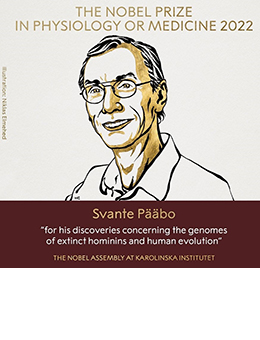
Нобелівську премію з фізіології або медицини у 2022 р. присуджено шведському досліднику-палеогенетику, фахівцю в галузі еволюційної генетики, директору відділу генетики Інституту еволюційної антропології імені Макса Планка в Лейпцигу (Німеччина) професору Сванте Пеебо (Svante Pääbo) за «відкриття, що стосуються геномів вимерлих гомінідів і еволюції людини». Пояснюючи значення робіт С. Пеебо, Нобелівський комітет зазначив, що «він розробив методи аналізу та відновлення прадавньої ДНК. У давніх кістках ДНК розкладається, зазнає хімічного пошкодження, а також сильно забруднюється від контакту з бактеріями та людьми, які працюють зі зразками. Використовуючи наявні технології в міру їх розвитку, С. Пеебо створив власні методи для уточнення аналізу прадавньої ДНК».
Посилання
Physiology or Medicine. 2022 Citation Laureates. https://clarivate.com/citation-laureates/physiology-or-medicine-2022/
Press release: The Nobel Prize in Physiology or Medicine 2022. https://www.nobelprize.org/prizes/medicine/2022/press-release/
Svante Pääbo. Wikipedia. https://en.wikipedia.org/wiki/Svante_Pääbo
Hedestam G.K. Discoveries concerning the genomes of extinct hominins and human evolution. https://www.nobelprize.org/prizes/medicine/2022/advanced-information/
Zukerkandl E., Pauling L. Molecules as documents of evolutionary history. J. Theor. Biol. 1965. 8(2): 357—366. https://doi.org/10.1016/0022-5193(65)90083-4
Pääbo S. Molecular cloning of Ancient Egyptian mummy DNA. Nature. 1985. 314(6012): 644—645. https://doi.org/10.1038/314644a0
Cann R.L., Stoneking M., Wilson A.C. Mitochondrial DNA and human evolution. Nature. 1987. 325(6099): 31—36. https://doi.org/10.1038/325031a0
Paabo S., Wilson A.C. Polymerase chain reaction reveals cloning artefacts. Nature. 1988. 334(6181): 387—388. https://doi.org/10.1038/334387b0
Kocher T.D., Thomas W.K., Meyer A., Edwards S.V., Pääbo S., Villablanca F.X., Wilson A.C. Dynamics of mitochondrial DNA evolution in animals: amplification and sequencing with conserved primers. Proc. Natl. Acad. Sci. USA. 1989. 86(16): 6196—6200. https://doi.org/10.1073/pnas.86.16.6196
Poinar H.N., Höss M., Bada J.L., Pääbo S. Amino acid racemization and the preservation of ancient DNA. Science. 1996. 272(5263): 864—866. https://doi.org/10.1126/science.272.5263.864
Mooallemjan J. Neanderthals were people, too. https://www.nytimes.com/2017/01/11/magazine/neanderthals-were-people-too.html
Krings M., Stone A., Schmitz R.W., Krainitzki H., Stoneking M., Pääbo S. Neandertal DNA sequences and the origin of modern humans. Cell. 1997. 90(1): 19—30. https://doi.org/10.1016/s0092-8674(00)80310-4
Lander E.S., Linton L.M., Birren B., 253 co-authors; International Human Genome Sequencing Consortium. Initial sequencing and analysis of the human genome. Nature. 2001. 409(6822): 860—921. https://doi.org/10.1038/35057062
Nurk S., Koren S., Rhie A., 96 co-authors, Phillippy A.M. The complete sequence of a human genome. Science. 2022. 376(6588): 44—53. https://doi.org/10.1126/science.abj6987
Venter J.C., Adams M.D., Myers E.W., 270 co-authors, Zhu X. The sequence of the human genome. Science. 2001. 291(5507): 1304—1351. https://doi.org/10.1126/science.1058040
Margulies M., Egholm M., Altman W.E., 52 co-authors, Rothberg J.M. Genome sequencing in microfabricated high-density picolitre reactors. Nature. 2005. 437(7057): 376—380. https://doi.org/10.1038/nature03959
Green R.E., Krause J., Briggs A.W., 52 co-authors, Pääbo S. A draft sequence of the Neandertal genome. Science. 2010. 328(5979): 710—722. https://doi.org/10.1126/science.1188021
Krause J., Fu Q., Good J.M., Viola B., Shunkov M.V., Derevianko A.P., Pääbo S. The complete mitochondrial DNA genome of an unknown hominin from southern Siberia. Nature. 2010. 464(7290): 894—897. https://doi.org/10.1038/nature08976
Meyer M., Kircher M., Gansauge M.T., 30 co-authors, Pääbo S. A high-coverage genome sequence from an archaic Denisovan individual. Science. 2012. 338(6104): 222—226. https://doi.org/10.1126/science.122434
Fu Q., Hajdinjak M., Moldovan O.T., 12 coauthors, Pääbo S. An early modern human from Romania with a recent Neanderthal ancestor. Nature. 2015. 524(7564): 216—219. https://doi.org/10.1038/nature14558
Fu Q., Li H., Moorjani P., 24 coauthors, Pääbo S. Genome sequence of a 45,000-year-old modern human from western Siberia. Nature. 2014. 514(7523): 445—449. https://doi.org/10.1038/nature13810
Callaway E. Modern human genomes reveal our inner Neanderthal. https://www.nature.com/articles/nature.2014.14615
Gibbons A. Modern human females and male Neandertals had trouble making babies. Here’s why. https://www.science.org/content/article/modern-human-females-and-male-neandertals-had-trouble-making-babies-here-s-why
Uthmeier T. On the trail of the last Neanderthals. https://www.fau.eu/2013/06/05/news/research/on-the-trail-of-the-last-neanderthals/
Prüfer K., Racimo F., Patterson N., 41 co-authors, Pääbo S. The complete genome sequence of a Neanderthal from the Altai Mountains. Nature. 2014. 505(7481): 43—49. https://doi.org/10.1038/nature12886
Krause J., Lalueza-Fox C., Orlando L., Enard W., Green R.E., Burbano H.A., Hublin J.J., Hänni C., Fortea J., de la Rasilla M., Bertranpetit J., Rosas A., Pääbo S. The derived FOXP2 variant of modern humans was shared with Neandertals. Curr. Biol. 2007. 17(21): 1908—1912. https://doi.org/10.1016/j.cub.2007.10.008
Huerta-Sánchez E., Jin X., Asan, 23 coauthors, Nielsen R. Altitude adaptation in Tibetans caused by introgression of Denisovan-like DNA. Nature. 2014. 512(7513): 194—197. https://doi.org/10.1038/nature13408
Dannemann M., Kelso J. The contribution of Neanderthals to phenotypic variation in modern humans. Am. J. Hum. Genet. 2017. 101(4): 578—589. https://doi.org/10.1016/j.ajhg.2017.09.010
Ding Q., Hu Y., Xu S., Wang J., Jin L. Neanderthal introgression at chromosome 3p21.31 was under positive natural selection in East Asians. Mol. Biol. Evol. 2014. 31(3): 683—695. https://doi.org/10.1093/molbev/mst260
Dannemann M., Andrés A.M., Kelso J. Introgression of Neandertal- and Denisovan-like haplotypes contributes to adaptive variation in human Toll-like receptors. Am. J. Hum. Genet. 2016. 98(1): 22—33. https://doi.org/10.1016/j.ajhg.2015.11.015
Mendez F.L., Watkins J.C., Hammer M.F. A haplotype at STAT2 introgressed from neanderthals and serves as a candidate of positive selection in Papua New Guinea. Am. J. Hum. Genet. 2012. 91(2): 265—274. https://doi.org/10.1016/j.ajhg.2012.06.015
Mendez F.L., Watkins J.C., Hammer M.F. Neandertal origin of genetic variation at the cluster of OAS immunity genes. Mol. Biol. Evol. 2013. 30(4): 798—801. https://doi.org/10.1093/molbev/mst004
Zeberg H., Pääbo S. A genomic region associated with protection against severe COVID-19 is inherited from Neandertals. Proc. Natl. Acad. Sci. USA. 2021. 118(9): e2026309118. https://doi.org/10.1073/pnas.2026309118
Zeberg H., Pääbo S. The major genetic risk factor for severe COVID-19 is inherited from Neanderthals. Nature. 2020. 587(7835): 610—612. https://doi.org/10.1038/s41586-020-2818-3
Zimmer C. Man’s genome from 45,000 years ago is reconstructed. https://www.nytimes.com/2014/10/23/science/research-humans-interbred-with-neanderthals.html
Meyer M., Arsuaga J.L., de Filippo C., Nagel S., Aximu-Petri A., Nickel B., Martínez I., Gracia A., Bermúdez de Castro J.M., Carbonell E., Viola B., Kelso J., Prüfer K., Pääbo S. Nuclear DNA sequences from the Middle Pleistocene Sima de los Huesos hominins. Nature. 2016. 531(7595): 504—507. https://doi.org/10.1038/nature17405
Genomes Project Consortium, Abecasis G.R., Altshuler D., Auton A., Brooks L.D., Durbin R.M., Gibbs R.A., Hurles M.E., McVean G.A. A map of human genome variation from population-scale sequencing. Nature. 2010. 467(7319): 1061—1073. https://doi.org/10.1038/nature09534
Mallick S., Li H., Lipson M., 75 co-authors, Reich D. The Simons Genome Diversity Project: 300 genomes from 142 diverse populations. Nature. 2016. 538(7624): 201—206. https://doi.org/10.1038/nature18964
Moraes F., Góes A. A decade of human genome project conclusion: Scientific diffusion about our genome knowledge. Biochem. Mol. Biol. Educ. 2016. 44(3): 215—223. https://doi.org/10.1002/bmb.20952
Davis N. Ancient Siberia was home to previously unknown humans, say scientists. https://www.theguardian.com/science/2019/jun/05/ancient-siberia-was-home-to-previously-unknown-humans-say-scientists
Wade L. Mummy genomes reveal just how catastrophic European contact was for New World. https://www.science.org/content/article/mummy-genomes-reveal-just-how-catastrophic-european-contact-was-new-world
Price M. Oldest cousin of Native Americans found in Russia. https://www.science.org/content/article/oldest-cousin-native-americans-found-russia
Balter M. Mysterious Indo-European homeland may have been in the steppes of Ukraine and Russia. https://www.science.org/content/article/mysterious-indo-european-homeland-may-have-been-steppes-ukraine-and-russia
Yamnaya culture. Wikipedia. https://en.wikipedia.org/wiki/Yamnaya_culture
Pennisi E. Humans are still evolving – and we can watch it happen. https://www.science.org/content/article/humans-are-still-evolving-and-we-can-watch-it-happen
Gibbons A. How Europeans evolved white skin. https://www.science.org/content/article/how-europeans-evolved-white-skin
Gramling C. The ‘hobbit’ was a separate species of human, new dating reveals. https://www.science.org/content/article/hobbit-was-separate-species-human-new-dating-reveals
Gibbons A. New human species discovered. https://www.science.org/doi/10.1126/science.349.6253.1149
Gibbons A. First DNA extracted from an ancient African skeleton shows widespread mixing with Eurasians. https://www.science.org/content/article/first-dna-extracted-ancient-african-skeleton-shows-widespread-mixing-eurasians
Price M. Africans, too, carry Neanderthal genetic legacy. Science. 2020. 367(6477): 497. https://doi.org/10.1126/science.367.6477.497
Marchant J. Egyptian mummies yield genetic secrets. https://www.nature.com/news/egyptian-mummies-yield-genetic-secrets-1.12793
Gibbons A. DNA from cave dirt tells tale of how some Neanderthals disappeared. https://www.science.org/content/article/dna-cave-dirt-tells-tale-how-some-neanderthals-disappeared
Warren M. Biggest Denisovan fossil yet spills ancient human's secrets. Nature. 2019. 569(7754): 16—17. https://doi.org/10.1038/d41586-019-01395-0
Bahrampour T. They considered themselves white, but DNA tests told a more complex story. https://www.washingtonpost.com/local/social-issues/they-considered-themselves-white-but-dna-tests-told-a-more-complex-story/2018/02/06/16215d1a-e181-11e7-8679-a9728984779c_story.html
Vasiljevic N., Lim M., Humble E., Seah A., Kratzer A., Morf N.V., Prost S., Ogden R. Developmental validation of Oxford Nanopore Technology MinION sequence data and the NGSpeciesID bioinformatic pipeline for forensic genetic species identification. Forensic Sci. Int. Genet. 2021. 53: 102493. https://doi.org/10.1016/j.fsigen.2021.102493
Ponce de León M.S., Bienvenu T., Marom A., Engel S., Tafforeau P., Alatorre Warren J.L., Lordkipanidze D., Kurniawan I., Murti D.B., Suriyanto R.A., Koesbardiati T., Zollikofer C.P.E. The primitive brain of early Homo. Science. 2021. 372(6538): 165—171. https://doi.org/10.1126/science.aaz0032
Richerson P.J., Gavrilets S., de Waal F.B.M. Modern theories of human evolution foreshadowed by Darwin's Descent of Man. Science. 2021. 372(6544): eaba3776. https://doi.org/10.1126/science.aba3776
Dolgin E. Evolutionary sprint made us human. https://www.science.org/content/article/evolutionary-sprint-made-us-human
Pennisi E. Virus fighter may have played a key role in human evolution. https://www.science.org/content/article/virus-fighter-may-have-played-key-role-human-evolution
Reardon S. Step aside CRISPR, RNA editing is taking off. Nature. 2020. 578(7793): 24—27. https://doi.org/10.1038/d41586-020-00272-5
Grover N. Swedish geneticist wins Nobel medicine prize for decoding ancient DNA. https://www.reuters.com/world/svante-paabo-wins-2022-nobel-prize-medicine-2022-10-03/