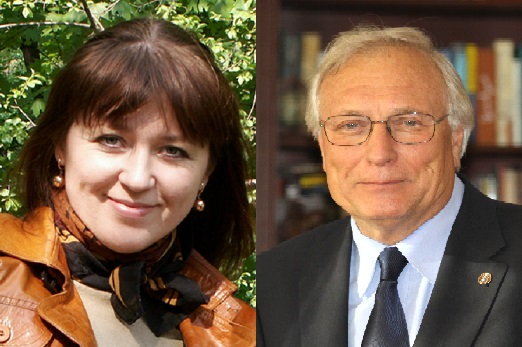
Прорив у прогнозуванні просторової структури та обчислювальному дизайні протеїнів, або чи можна вірити передбаченням штучного інтелекту
DOI:
https://doi.org/10.15407/visn2025.02.016Ключові слова:
Нобелівська премія з хімії 2024 року, Девід Бейкер, Деміс Гассабіс, Джон Джампер, проєктування білків, прогнозування структури протеїнів.Анотація
Автори статті аналізують Нобелівську премію з хімії 2024 р., яку було присуджено американському біохіміку та комп’ютерному біологу Девіду Бейкеру (David Baker) за «комп'ютерний дизайн білків», а також представникам компанії Google DeepMind: британському фахівцю з систем штучного інтелекту Демісу Гассабісу (Demis Hassabis) і американському хіміку та інформатику Джону Джамперу (John M. Jumper) за «прогнозування структури білка». Досягнення нобелівських лауреатів у галузі обчислювального проєктування протеїнів та прогнозування їхньої структури відкрили нову еру біохімічних і біологічних досліджень, що в поєднанні із застосуванням інструментів штучного інтелекту матиме далекосяжні наслідки для людства.
Посилання
Huang B. et al. Protein Structure Prediction: Challenges, Advances, and the Shift of Research Paradigms. Genomics, Proteomics & Bioinformatics. 2023. 21(5): 913—925. https://doi.org/10.1016/j.gpb.2022.11.014
Pearce R., Zhang Y. Toward the solution of the protein structure prediction problem. J. Biol. Chem. 2021. 297(1): 100870. https://doi.org/10.1016/j.jbc.2021.100870
Chou P.Y., Fasman G.D. Prediction of protein conformation. Biochemistry. 1974. 13(2): 222—245. https://doi.org/10.1021/bi00699a002
Regan L., DeGrado W.F. Characterization of a helical protein designed from first principles. Science. 1988. 241(4868): 976—978. https://doi.org/10.1126/science.3043666
Dahiyat B.I., Mayo S.L. De novo protein design: fully automated sequence selection. Science. 1997. 278(5335): 82—87. https://doi.org/10.1126/science.278.5335.82
Duan Y., Kollman P.A. Pathways to a protein folding intermediate observed in a 1-microsecond simulation in aqueous solution. Science. 1998. 282(5389): 740—744. https://doi.org/10.1126/science.282.5389.740
Göbel U., Sander C., Schneider R., Valencia A. Correlated mutations and residue contacts in proteins. Proteins. 1994. 18(4): 309—317. https://doi.org/10.1002/prot.340180402
Qian N., Sejnowski T.J. Predicting the secondary structure of globular proteins using neural network models. J. Mol. Biol. 1988. 202(4): 865—884. https://doi.org/10.1016/0022-2836(88)90564-5
Sklar J. QnAs with Demis Hassabis and John M. Jumper: Winners of the 2023 Albert Lasker Basic Medical Research Award. Proc. Natl. Acad. Sci. 2023. 120(39): e2313816120. https://doi.org/10.1073/pnas.2313816120
Tunyasuvunakool K. et al. Highly accurate protein structure prediction for the human proteome. Nature. 2021. 596(7873): 590—596. https://doi.org/10.1038/s41586-021-03828-1
Simons K.T., Bonneau R., Ruczinski I., Baker D. Ab initio protein structure prediction of CASP III targets using ROSETTA. Proteins. 1999. 3: 171—176. https://doi.org/10.1002/(sici)1097-0134(1999)37:3+<171::aid-prot21>3.3.co;2-q
Jones T.A., Thirup S. Using known substructures in protein model building and crystallography. EMBO J. 1986. 5(4): 819—822. https://doi.org/10.1002/j.1460-2075.1986.tb04287.x
Cooper S., Khatib F., Treuille A., Barbero J., Lee J., Beenen M., Leaver-Fay A., Baker D., Popović Z., Players F. Predicting protein structures with a multiplayer online game. Nature. 2010. 466(7307): 756—760. https://doi.org/10.1038/nature09304
Kuhlman B., Dantas G., Ireton G.C., Varani G., Stoddard B.L., Baker D. Design of a novel globular protein fold with atomic-level accuracy. Science. 2003. 302(5649): 1364—1368. https://doi.org/10.1126/science.1089427
Röthlisberger D. et al. Kemp elimination catalysts by computational enzyme design. Nature. 2008. 453(7192): 190—195. https://doi.org/10.1038/nature06879
Tinberg C.E. et al. Computational design of ligand-binding proteins with high affinity and selectivity. Nature. 2013. 501(7466): 212—216. https://doi.org/10.1038/nature12443
Langan R.A. et al. De novo design of bioactive protein switches. Nature. 2019. 572(7768): 205—210. https://doi.org/10.1038/s41586-019-1432-8
Bale J.B., Gonen S., Liu Y., Sheffler W., Ellis D., Thomas C., Cascio D., Yeates T.O., Gonen T., King N.P., Baker D. Accurate design of megadalton-scale two-component icosahedral protein complexes. Science. 2016. 353(6297): 389—394. https://doi.org/10.1126/science.aaf8818
Humphreys I.R. et al. Computed structures of core eukaryotic protein complexes. Science. 2021. 374(6573): eabm4805. https://doi.org/10.1126/science.abm4805
AI's potential to accelerate drug discovery needs a reality check. Nature. 2023. 622(7982): 217. https://doi.org/10.1038/d41586-023-03172-6
Agard D.A., Bowman G.R., DeGrado W., Dokholyan N.V., Zhou H.X. Solution of the protein structure prediction problem at last: crucial innovations and next frontiers. Fac. Rev. 2022. 11: 38. https://doi.org/10.12703/r-01-0000020
Arnold C. AlphaFold touted as next big thing for drug discovery — but is it? Nature. 2023. 622(7981): 15—17. https://doi.org/10.1038/d41586-023-02984-w
Ren F. et al. A small-molecule TNIK inhibitor targets fibrosis in preclinical and clinical models. Nat. Biotechnol. 2024. https://doi.org/10.1038/s41587-024-02143-0
Mullard A. When can AI deliver the drug discovery hits? Nat. Rev. Drug Discov. 2024. 23(3): 159—161. https://doi.org/10.1038/d41573-024-00036-0
Callaway E. 'A landmark moment': scientists use AI to design antibodies from scratch. Nature. 2024. Mar 19. https://doi.org/10.1038/d41586-024-00846-7
Callaway E. How AlphaFold and other AI tools could help us prepare for the next pandemic. Nature. 2023. 622(7983): 440—441. https://doi.org/10.1038/d41586-023-03201-4
Dolgin E. 'Remarkable' AI tool designs mRNA vaccines that are more potent and stable. Nature. 2023. May 2. https://doi.org/10.1038/d41586-023-01487-y
Ko K.T. et al. Structure of the malaria vaccine candidate Pfs48/45 and its recognition by transmission blocking antibodies. Nat. Commun. 2022. 13(1): 5603. https://doi.org/10.1038/s41467-022-33379-6
Callaway E. AlphaFold tool pinpoints protein mutations that cause disease. Nature. 2023. Sep 19. https://doi.org/10.1038/d41586-023-02943-5
Topol E.J. The revolution in high-throughput proteomics and AI. Science. 2024. 385(6716): eads5749. https://doi.org/10.1126/science.ads5749
Eisenstein M. AI under the microscope: the algorithms powering the search for cells. Nature. 2023. 623(7989): 1095—1097. https://doi.org/10.1038/d41586-023-03722-y
Prillaman M. Is ChatGPT making scientists hyper-productive? The highs and lows of using AI. Nature. 2024. 627(8002): 16—17. https://doi.org/10.1038/d41586-024-00592-w
Conroy G. How ChatGPT and other AI tools could disrupt scientific publishing. Nature. 2023. 622(7982): 234—236. https://doi.org/10.1038/d41586-023-03144-w
Savage N. Drug discovery companies are customizing ChatGPT: here's how. Nat. Biotechnol. 2023. 41(5): 585—586. https://doi.org/10.1038/s41587-023-01788-7
Callaway E. Could AI-designed proteins be weaponized? Scientists lay out safety guidelines. Nature. 2024. 627(8004): 478. https://doi.org/10.1038/d41586-024-00699-0
Turing A.M. Computing machinery and intelligence. Mind. 1950. LIX(59): 433—460. https://doi.org/10.1093/mind/LIX.236.433
ChatGPT is a black box: how AI research can break it open. Nature. 2023. 619(7971): 671—672. https://doi.org/10.1038/d41586-023-02366-2